
In ancient times the most common form of advertising was by word of mouth; however, commercial messages and political campaign displays have been found in the ruins of Pompeii. Egyptians used papyrus to create sales messages and wall posters, while lost-and-found advertising on papyrus was common in Greece and Rome. Wall or rock painting for commercial advertising is another manifestation of an ancient media advertising form, which is present to this day in many parts of Asia, Africa, and South America. For instance, the tradition of wall paintings can be traced back to Indian rock-art paintings that goes back to 4000 BC[1]. As printing developed in the 15th and 16th century, advertising expanded to include handbills. In the 17th century advertisements started to appear in weekly newspapers in England.
These early print ads were used mainly to promote books, which became increasingly affordable thanks to the printing press, and medicines, which were increasingly sought after as disease ravaged Europe. However, false advertising and so-called "quack" ads became a problem, which ushered in regulation of advertising content.
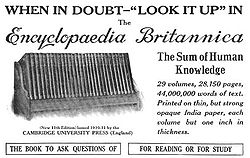
A print advertisement for the 1913 issue of the Encyclopaedia Britannica
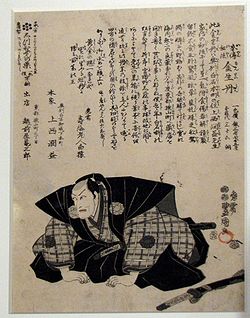
Edo period advertising flier from 1806 for a traditional medicine called Kinseitan
As the economy was expanding during the 19th century, the need for advertising grew at the same pace. In the United States, classified ads became popular, filling pages of newspapers with small print messages promoting all kinds of goods. The success of this advertising format led to the growth of mail-order advertising such as the Sears Catalog, at one time referred to as the "Farmer's Bible". In 1843 the first advertising agency was established by Volney Palmer in Philadelphia. At first the agencies were just brokers for ad space in newspapers, but by the 20th century, advertising agencies started to take over responsibility for the content as well.
The 1960s saw advertising transform into a modern, more scientific approach in which creativity was allowed to shine, producing unexpected messages that made advertisements more tempting to consumers' eyes. The Volkswagen ad campaign featuring such headlines as "Think Small" and "Lemon" ushered in the era of modern advertising by promoting a "position" or "unique selling proposition" designed to associate each brand with a specific idea in the reader or viewer's mind.
The late 1980s and early 1990s saw the introduction of cable television and particularly MTV. Pioneering the concept of the music video, MTV ushered in a new type of advertising: the consumer tunes in for the advertisement, rather than it being a byproduct or afterthought. As cable (and later satellite) television became increasingly prevalent, "specialty" channels began to emerge, and eventually entire channels, such as QVC and Home Shopping Network and ShopTV, devoted to advertising merchandise, where again the consumer tuned in for the ads.
Marketing through the Internet opened new frontiers for advertisers and led to the "dot-com" boom of the 1990s. Entire corporations operated solely on advertising revenue, offering everything from coupons to free Internet access. At the turn of the 21st century, the search engine Google revolutionized online advertising by emphasizing contextually relevant, unobtrusive ads intended to help, rather than inundate, users. This has led to a plethora of similar efforts and an increasing trend of interactive advertising.
Today, innovations as "guerrilla promotions", which involve unusual approaches such as staged encounters in public places, giveaways of products such as cars that are covered with brand messages, and interactive advertising where the viewer can respond to become part of the advertising message. This reflects an increasing trend of interactive and "embedded" ads, such as via product placement, having consumers vote through text messages, and various innovations utilizing social networking sites (e.g. Myspace).